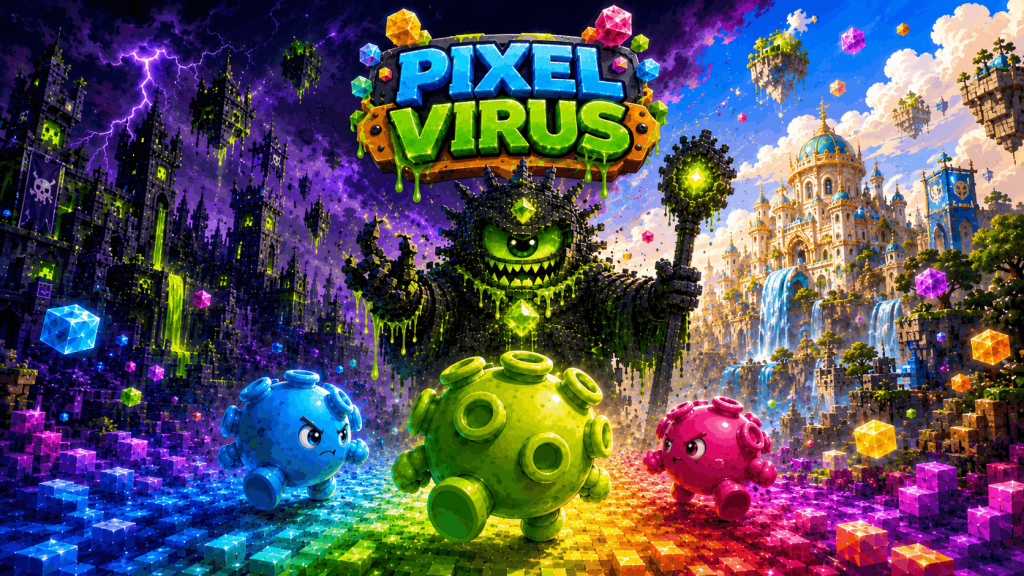

Building a mobile game today is not only about having a strong idea. It is about turning that idea into a playable, scalable, and visually memorable experience fast enough to keep up with the pace of the market.
For Pixel Virus, this challenge became the foundation of our entire production approach.
At Digidodo Games, we built Pixel Virus through an AI-driven production pipeline designed to support creativity, speed, iteration, and scalability. But for us, AI is not a shortcut that replaces imagination. It is a production force that helps us explore more ideas, test more possibilities, and refine the game world with greater speed and flexibility.
Pixel Virus is the result of that balance: human creativity shaped by intelligent production systems.
From First Idea to Playable World
Pixel Virus began with a simple but powerful question:
What if clearing a level did not just mean winning, but restoring life to a broken universe?
That idea became the emotional core of the game. The player would not simply destroy blocks or complete puzzles. They would fight against a pixel curse, restore color, and bring the Viopix Universe back to life one pixel at a time.
Once this core fantasy was defined, our AI-assisted workflow helped us move quickly from concept exploration to visual direction, character development, and gameplay prototyping.
Instead of spending weeks locked into a single visual route, we were able to explore multiple possibilities early in the process: different pixel styles, color systems, enemy concepts, region moods, character silhouettes, and animation directions.
This allowed us to make creative decisions faster without losing control of the artistic vision.
Designing the Viopix Universe
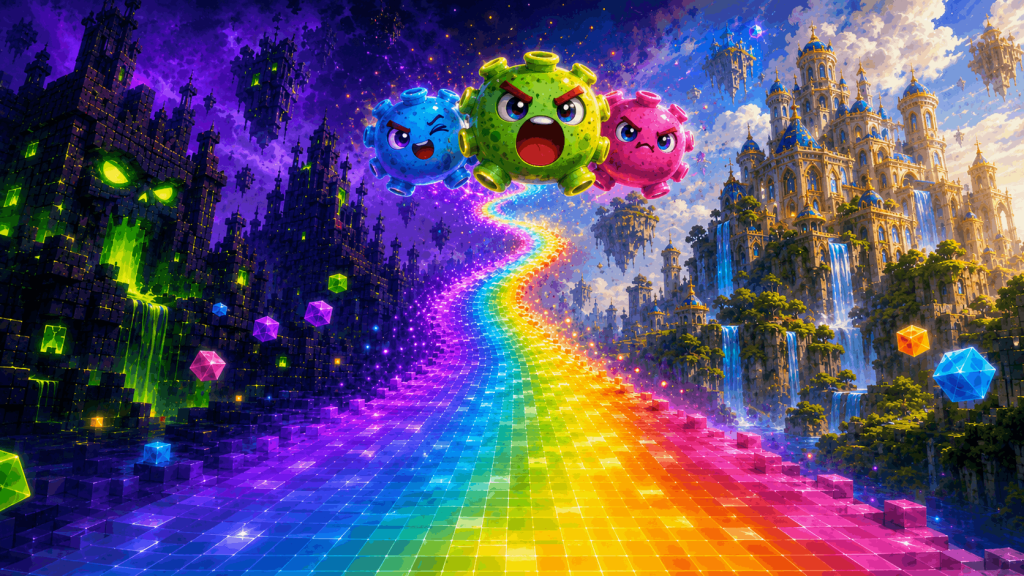
The world of Pixel Virus is built around contrast.
Viopix was once a vibrant digital universe full of movement, color, and energy. After the arrival of Volnox, that life was frozen into grey, lifeless pixel layers.
This contrast became one of the most important visual ideas in the game:
a world moving from corruption to restoration, from silence to rhythm, from grey to glow.
Through our AI-driven production pipeline, we explored different ways to represent this transformation. We tested color palettes, environmental textures, region identities, and visual effects that could make every restored pixel feel meaningful.
The goal was not only to create a beautiful world.
The goal was to create a world that reacts to the player.
Every restored area needed to feel like progress. Every burst of color needed to feel like a small victory. Every level needed to carry the feeling that Viopix is slowly coming back to life.
Creating Piko, Nano, and Tera
One of the most exciting parts of the Pixel Virus production process was designing the legendary trio: Piko, Nano, and Tera.
Each character had to feel visually distinct, emotionally readable, and mechanically useful.
Piko needed to communicate speed and energy.
Nano needed to feel precise, tactical, and focused.
Tera needed to carry weight, power, and impact.
Using AI-assisted visual exploration, we generated and compared different character shapes, proportions, expressions, movement styles, and personality cues. This helped us quickly understand what worked and what did not.
But the final decisions were never left to AI alone.
Our creative team shaped the characters around the gameplay experience. Piko, Nano, and Tera were not designed only to look appealing. They were designed to support the player’s strategy and make each action feel more satisfying.
Piko brings speed.
Nano brings precision.
Tera brings power.
Together, they give the player more than visual companions. They create tactical variety inside the action-puzzle structure of Pixel Virus.
Prototyping Faster, Learning Faster
Hybrid-casual games live or die by their core loop.
The idea may sound strong on paper, but the real question is always the same:
Does it feel good to play?
That is why rapid prototyping became a central part of our pipeline.
The Future of Pixel Virus
Pixel Virus is planned to launch on iOS and Android in 2026.
For us, this is not only the launch of a game. It is the first real milestone of the Digidodo Games production model.
With Pixel Virus, we are testing and proving a new way of building hybrid-casual mobile games: one where AI-driven production, creative design, and scalable development work together from day one.
The battle for Viopix begins soon.
And behind every restored pixel, there is a production pipeline built to imagine faster, test smarter, and create at scale.
Digidodo Games — Fusing imagination with AI-driven production.